
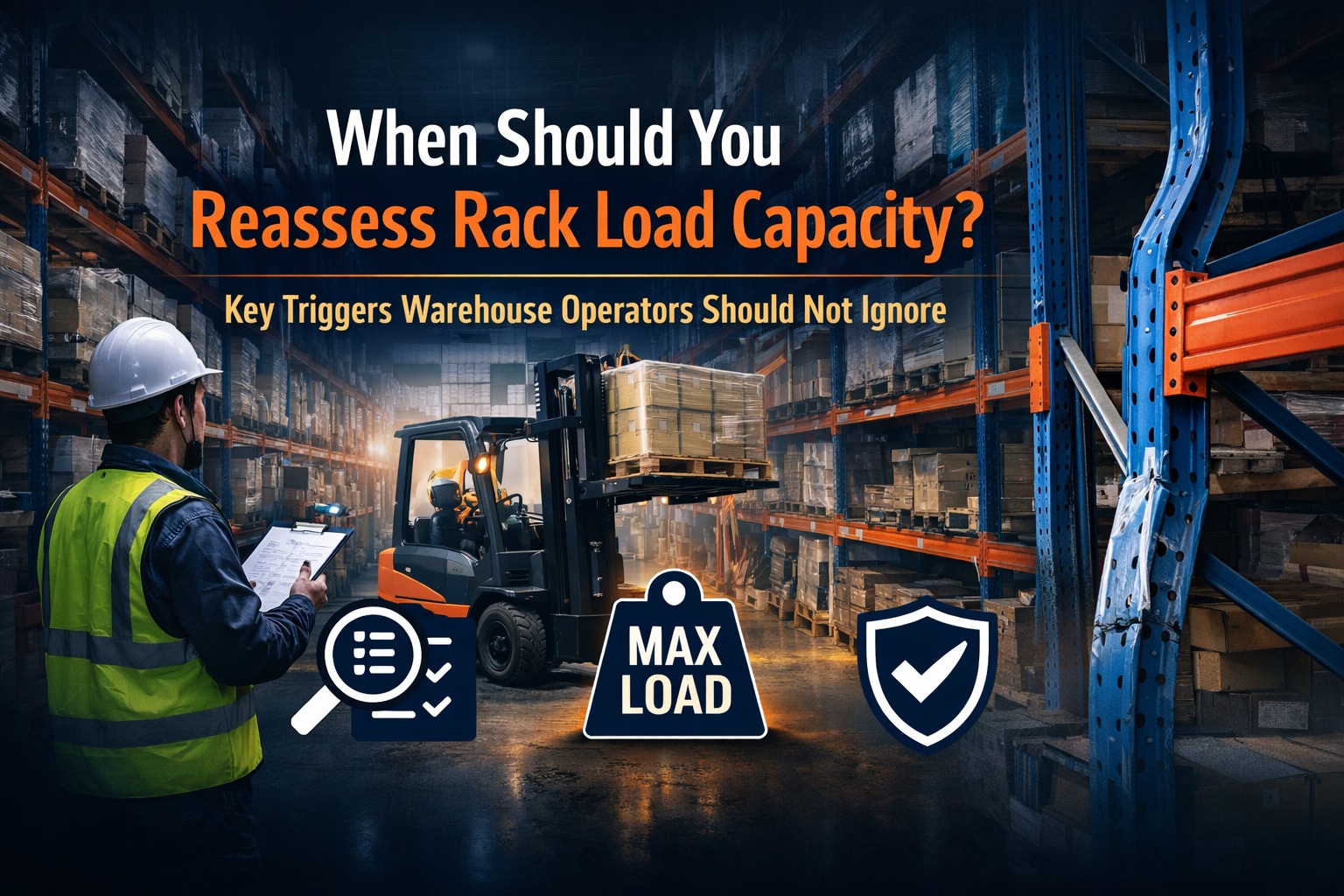
Key Triggers Warehouse Operators Should Not Ignore
Warehouse racking systems are often designed with a specific load capacity based on initial operational requirements. However, operations rarely stay static. Over time, changes in products, handling methods, and layout can significantly affect how loads are distributed across the system.
Failing to reassess rack load capacity after such changes can introduce hidden structural risks, even if the racks appear visually sound.
This article outlines the key triggers that indicate when a reassessment is necessary.
1. Change in Pallet Weight or Load Type
One of the most common risks arises when:
- Heavier goods are introduced
- Load density increases (e.g. solid cartons vs mixed loads)
- Pallet types change (e.g. from standard pallets to plastic or damaged pallets)
Even if the difference seems minor, cumulative loading across multiple beam levels can exceed the original design capacity.
Key risk:
Load assumptions used in the original design are no longer valid.
2. Modification of Rack Configuration
Any physical change to the racking system should trigger a reassessment, including:
- Adding or removing beam levels
- Changing beam elevations
- Extending bay lengths
- Converting layouts (e.g. selective to drive-in)
These changes alter load paths and structural behaviour.
Key risk:
The rack is no longer performing as per its original engineered design.
3. Installation or Change of Decking
Decking plays a critical role in load distribution.
Examples include:
- Adding wire mesh decking
- Replacing timber with steel panels
- Using non-standard or modified decking
Different decking types have different deflection limits and load-sharing characteristics.
Key risk:
Decking may fail before the rack structure, especially if not designed for the applied load.
4. Frequent Overloading or Operational Misuse
In some warehouses, overloading may occur unintentionally due to:
- Lack of load signage
- Poor inventory control
- Mixed pallet storage
Repeated overloading can lead to:
- Permanent beam deflection
- Connection fatigue
- Progressive structural weakening
Key risk:
Damage accumulates over time, reducing the safety margin.
5. Forklift Impact or Visible Damage
Even minor impacts can compromise structural integrity.
Common damage includes:
- Bent uprights
- Twisted beams
- Dislodged connectors
Such damage may not immediately lead to failure but can significantly reduce load capacity.
Key risk:
Localised damage affects overall system stability.
6. Change in Material Handling Equipment
Switching equipment can introduce new risks, for example:
- Heavier forklifts increasing impact forces
- Different reach trucks altering loading patterns
- Increased operational speed
Key risk:
Higher dynamic loads and impact frequency.
7. Warehouse Relocation or Reinstallation
When racks are dismantled and reinstalled:
- Components may be mixed or mismatched
- Bolts and connections may not be restored correctly
- Original specifications may no longer apply
Key risk:
Loss of traceability and design integrity.
8. Long Service Life Without Assessment
Racking systems in long-term use may experience:
- Material fatigue
- Corrosion (especially in humid environments)
- Undetected progressive deformation
Key risk:
Reduced structural reliability over time.
What Should a Reassessment Involve?
A proper reassessment should go beyond visual checks and include:
- Verification of current loading conditions
- Structural review against design standards
- Measurement of deflection and deformation
- Identification of damaged or non-compliant components
Where necessary, a Professional Engineer (PE) assessment or load test provides the highest level of assurance.
Conclusion
Racking systems are not “install and forget” structures.
They are part of a dynamic operational environment where risks evolve over time.
Reassessing rack load capacity is not only a compliance matter—it is a critical safety measure to prevent structural failure, protect workers, and ensure business continuity.
If your warehouse has undergone any of the changes listed above, it is advisable to conduct a professional evaluation before risks escalate.


